Showing posts with label van Gogh. Show all posts

Monday, December 6, 2010

Landscape, Still Life, and Collage

To recap what we've been doing the past couple of weeks: The week of Nov. 15th, just before Thanksgiving break, we learned all about Landscapes!
 The one featured above is by Asher Durand, an artist of the Hudson River School (HRS), and is titled Kindred Spirits. This painting paid homage to fellow artist Thomas Cole, and to the poet William Cullen Bryant. We talked about how this particular landscape combines elements of the Clove of the Catskills and also Kaaterskill Falls, becoming an "imaginary" landscape built from real locations.
Henri Rousseau's Landscape with Cattle
We looked at a number of different styles of landscape painting, comparing Durand's, and the HRS's romanticism-inspired works to Rousseau's primitive style . . .
The Starry Night by Vincent van Gogh (1889)
. . . and compared these to the post-impressionism work of Vincent van Gogh. We marveled over the impasto of van Gogh's painting, and his use of curvilinear lines.
View from Mount Holyoke, Northampton, Massachusetts, after a Thunderstorm--The Oxbow (1836) by Thomas Cole
Students learned about the Rule of Thirds, and how it applies to landscape. Then, we took turns pointing out the how this rule was applied in each work of art on display before creating our own landscapes.
Henri Rousseau's Virgin Forest at Sunset (1910)
After returning from Thanksgiving break, we learned about the genre of Still Life, and how this particular type of art allows the artist some flexibility--through arrangement, palette, etc. We talked about how this becomes a good "exercise" for the artist in terms of honing their skills.
Chardin's Still Life: Apples, Pear, and White Mug
We talked about popular themes in still life: fruit, flowers, vases, fabric--basically, things from everyday life.  We also discussed the works with regard to balance and symmetry, light and shadow, realism vs. stylization, warm vs. cool, and so on. 
van Gogh's Irises (1890)
We also discussed how, in a successful composition, the viewer's eye will first "land" somewhere on the painting, then "take off" and travel around a bit, before returning where it initially landed. We took turns talking about how each of us viewed the paintings, and then analyzed why our eyes wanted to go to various places first--what the artist did to manipulate the way we unconsciously view the work.
Cezanne's Still Life (c. 1890-1894)
For instance, Cezanne gives us an island of warm in a sea of cool. All of the wonderful visual texture surrounding the fruit makes our eyes want to look at, or travel around, the rest of the work, but those warm colors force us to come back. Brilliant!

Finally, young artists worked on a still life that was set up in the center of the room. I've said this before but it bears repeating: We have some fantastic artists in our school!

In ATCs, ACEOs, and Art in Miniature, we had a BLAST working on small-scale collage. First, we browsed magazines to find a small picture, or the single element of a picture, then carefully cut it out. Once done, we decided where this element would go on our paper and then carefully drew & colored in the background. Once this was done, our cut-out was glued down to complete the composition. We'll be completing and/or continuing these projects in the coming week, so check back next week for photos!
LAST WET CLAY DAY!!
That's right! Our last wet clay day will be this coming week (December 7th and 8th). Our works will need sufficient time to dry (become "bone dry") before they can be bisque fired. No worries, though, because we'll be super busy finishing works that have already been fired. Some things will require glazing (which means they'll need an additional firing), and some works will be finished in either acrylic paint or wax. Students: Please bring back any works that you would like to finish during the last few weeks of this semester. We'll be doing our "finishing" work on Dec. 14th-15th, and Jan. 4th-5th. 
Remember that WINTER BREAK is Dec. 20th-Jan. 3rd!
The End-of-Semester Art Show is Jan. 11th-12th!

Wednesday, November 3, 2010

Portrait and Self-Portrait

Self-Portrait, 2010, by Elisabeth B. (Age 8)
Okay, I have to make a confession: Artist's self-portraits have always fascinated me, and are by far one of my favorite subjects! Needless to say, this week's Explorations in Art lesson on portraits and self-portraits is also my favorite discussion (and project!) so far this semester. Students got an opportunity to see a variety of artist's self-portraits, as well as a few very famous portrait paintings. After our tour of the gallery, students spent the remainder of the class period either capturing the likeness of one of their classmates, or doing a self-portrait!
Self-Portrait, 1997, by Chuck Close. Oil on canvas.

Portraits and self-portraits can be created in a number of ways, and also in a variety of styles. For instance, Chuck Close's self-portrait (above) is a pseudo mosaic of painted squares which, when viewed close up, appears very abstract. Viewed from a distance, though, it takes on a photorealistic effect--almost like looking at Close through wavy, clear glass. Since 1988, Close has been confined to a wheelchair, and has adapted his easel to spin in a circle for easy access to all parts of the canvas. Because he usually works on a very large scale, most painted works take about 2 months to complete.
Albrecht Durer's Self-Portrait at 28, 1500. Oil on panel.

Portraits and self-portraits are well documented throughout art history. Some of the more famous of these, the Faiyum (or Fayum) portraits date back to the 1st century B.C., and were created with encaustic (wax) and tempera on wood.
Faiyum mummy portrait, c. 1st century B.C.

La Gioconda, commonly referred to as the Mona Lisa, is probably one of the most celebrated and recognized portraits of all time. It, along with Grant Wood's painting, American Gothic, is one of the most copied paintings in the history of Art. 
La Gioconda (Mona Lisa) by Leonardo da Vinci, 1503-1506. Oil on wood panel (below left) . . . and Salvador Dali's Self-Portrait as Mona Lisa ( below right), 1954

Above left: Grant Wood's American Gothic, 1930. Oil on beaverboard. Above Right: Robin Hernandez' Atchison Gothic, 2006. Acrylic on canvas.
We talked quite a bit about how artists are inspired by the works of other artists, and will often "borrow from," copy, or work in the style of others. Student's saw, first-hand, the influence Gustav Klimt, Grant Wood, Andy Warhol, and Frida Kahlo had on a number of portraits (and self-portraits) done by their very own art teacher!

The great thing about self-portraits is that the artist always has a subject available and ready to be captured on paper or canvas (or in a 3-dimensional medium!). Students were strongly encouraged (and challenged!) to do at least 1 self-portrait per year for the remainder of their lifetime.
Self-Portrait as a Cyprus Tree, 2001. Ceramic, acrylic, and wax (left); and Self-Portrait in Cool and Warm, 2003. Oil on canvas (right) by Robin Hernandez.

Many artists have built their oeuvres around portraits and self-portraits. Albrecht Durer's earliest known self-portrait was created when he was a mere 13 years old, and he continued to use himself as a subject throughout his entire lifetime. 
Portrait of Josh B., 2010, by Keith C. (Age 11)

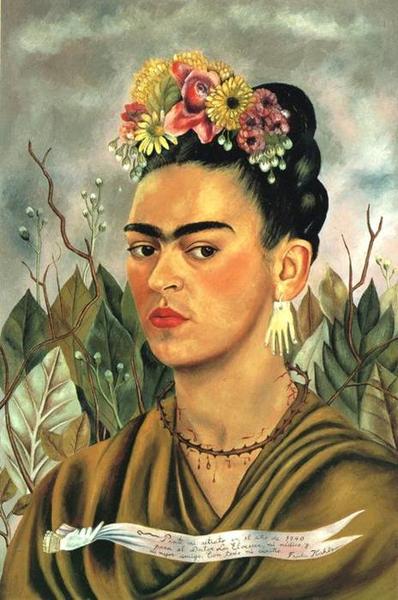
An artist most well known for her self-portraits is Frida Kahlo. She used this particular genre of painting to record events in her life and to express her feelings of pain and frustration. Because she spent a great deal of time confined to bed, she created much of her art while in the supine position, and used a mirror (attached to the bed above her) to do her work.
Self-Portrait Dedicated to Dr. Eloesser, 1940, by Frida Kahlo

Another artist well known for portraits and self-portraits is Andy Warhol, an icon of the Pop Art movement.
Andy Warhol's Self-Portrait, 1966. Silkscreen print.

Warhol was fascinated by celebrities and by popular culture. He used photos, either taken by him but often by others, to create colorful screen printed portraits. Often he would create multiple images of the same portrait. Sometimes he would re-ink the screen between printings, but more often he would create multiples from one inking which resulted in the degradation of the image.
Self-Portrait by Vincent van Gogh, 1889. Oil on canvas.

By now we've viewed many works by Vincent van Gogh, so students easily and quickly identify his work by the brush strokes and impasto of his paintings. He is another artist who did many portraits and self-portraits throughout his lifetime. According to Wikipedia, van Gogh painted himself 37 times between 1886 and 1889!
Dr. Martin L King by Diana Bracy. Fiber Art.
Students got the opportunity to see an original fiber (or textile) portrait done by artist Diana Bracy. Bracy uses assorted fabrics to create colorful, realistic portraits. Students in my ATC, ACEO, and Art in Miniature class will be interested to learn that Diana is also a big fan of ATCs and ACEOs, and if you visit her website, you'll get a chance to see miniature textile works by her, in addition to an amazing variety of portraits!
Self-Portrait by M. C. Escher, 1948. Lithograph

I feel pretty comfortable stating that any artist "worth their salt" has done one or more self-portraits throughout their career. 

Interestingly, many artists include very subtle (or not!) self-portraits within works that would be categorized as another genre. One of my absolute favorite artists who is "guilty" of this is Remedios Varo . . .
Exploration of the Sources of the Orinoco River, 1959.
Oil on canvas by Remedios Varo. In her book, Remedios Varo: Unexpected Journeys, author Janet A. Kaplan says, "The intrepid traveler in [this painting] is a most determined woman who bears particular resemblance to Varo herself."

. . . Varo created whimsical, dream-like surrealist worlds which were often filled with people--and sometimes animals--who looked just like her! 

I've often mentioned, in class, that artists will tend to depict people who look like themselves. Varo illustrates this point better than any amount of lecturing on my part, and does it in the most wonderful way!